Turbocharged vs. Naturally Aspirated Engines: Comparing Power and Efficiency
For decades, the automotive world lived by a simple maxim: there is no replacement for displacement. If an automaker wanted more horsepower, the solution was straightforward: cast a larger engine block, bore out the cylinders, and let atmospheric pressure do the rest. Today, that hierarchy has dissolved. Stricter emissions mandates and advancements in materials engineering have pushed forced induction into almost every vehicle category, from compact family crossovers to high-end sports coupes.
The debate between turbocharged (turbo) and naturally aspirated (NA) powerplants is no longer confined to track-day enthusiasts. It directly affects the fuel budget, maintenance schedule, and driving experience of everyday car buyers. Understanding how each engine operates reveals that the trade-off between instant throttle response and broad torque curves involves substantial compromises on both sides.
Fundamental Mechanics: How Each Engine Breathes
Every internal combustion engine functions essentially as an air pump. The volume of fuel an engine can burn efficiently is strictly limited by the mass of air it draws into the combustion chambers.
A naturally aspirated engine pulls ambient air directly into its cylinders through the vacuum created when the pistons move downward on the intake stroke. Because it operates strictly under normal atmospheric pressure (roughly 14.7 psi at sea level), its volumetric efficiency is naturally capped. An NA engine relies purely on displacement, intake manifold geometry, and valve timing to optimize the air charge entering the cylinder.
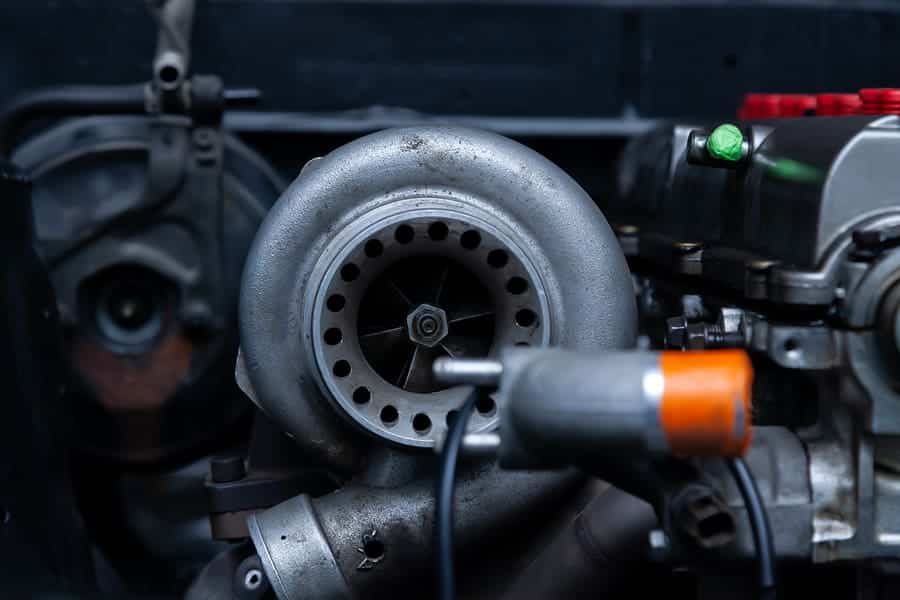
A turbocharged engine, by contrast, bypasses the limits of ambient air pressure by recycling wasted energy. It harnesses hot exhaust gases exiting the engine to spin a turbine wheel at speeds frequently exceeding 200,000 RPM. This turbine is connected via a shared shaft to a compressor wheel, which forces compressed, oxygen-dense air directly into the intake manifold. Because forced induction artificially increases cylinder pressure beyond atmospheric levels, a compact 2.0-liter turbocharged four-cylinder can match or exceed the peak output of a traditional 3.5-liter naturally aspirated V6.
Power Delivery and Driving Dynamics
While peak horsepower numbers on a specification sheet look identical regardless of how that power is generated, the way that power arrives at the drive wheels feels entirely distinct behind the wheel.
Linear Progression vs. Low-End Torque
Naturally aspirated engines are defined by their predictable, linear power delivery. Because engine output scales directly with engine speed, the driver experiences an unbroken, progressive buildup of power as the tachometer climbs toward redline. Throttle modulation is instantaneous; pressing the accelerator produces an immediate, proportional reaction at the crank without hesitation. For spirited cornering and track driving, this millisecond-level precision allows drivers to balance chassis weight transfer right at the limit of tire adhesion.
Turbocharged engines shift their performance window significantly lower in the rev range. Peak torque often arrives as early as 1,500 to 2,000 RPM and remains flat across a broad midrange plateau. In practical driving conditions—such as merging onto a busy highway or passing a slow truck on a two-lane road—a turbocharged vehicle delivers immediate thrust without requiring the transmission to drop multiple gears.
The Evolution of Turbo Lag
The traditional drawback of forced induction is turbo lag, the slight delay between depressing the accelerator pedal and the moment the turbocharger builds sufficient boost pressure to deliver acceleration. While older performance cars suffered from noticeable hesitations followed by sudden surges of power, modern engine designs have dramatically minimized this phenomenon.
Automakers utilize small, low-inertia turbine wheels, twin-scroll turbine housings that separate exhaust pulses, and variable-geometry vanes to spool up turbines almost instantaneously. Some premium manufacturers now integrate 48-volt mild-hybrid systems with electric auxiliary compressors to fill the torque gap before exhaust gases take over. Despite these improvements, an experienced driver will still notice the fraction-of-a-second latency in a turbocharged car when compared directly to the razor-sharp response of a well-tuned atmospheric engine.
Fuel Efficiency: Laboratory Ratings vs. Real-World Driving
On government test cycles, small-displacement turbocharged engines post impressive fuel economy figures. In steady-state testing scenarios with gentle acceleration, a smaller engine incurs lower pumping losses, reduced internal friction, and throttled fuel consumption simply because it possesses fewer cylinders and less reciprocating mass.
Real-world driving conditions, however, often tell a different story.
When a turbocharged engine operates outside of its low-load cruising state, fuel demand changes rapidly. Under aggressive throttle or sustained uphill climbs, the engine operates continuously under positive boost pressure. To prevent destructive engine knock (pre-ignition caused by intense heat and cylinder pressure), the engine control unit must inject additional fuel into the cylinders. This extra fuel is not just burned for power; it actively cools the piston tops and combustion chambers. Consequently, drivers with aggressive driving habits frequently discover that their downsized turbo four-cylinder returns gas mileage comparable to—or worse than—the larger naturally aspirated six-cylinder it replaced.
Naturally aspirated engines, on the other hand, demonstrate far less variance between gentle driving and heavy-footed commuting. Because they do not need to dump excess fuel to mitigate extreme thermal conditions inside the cylinders, their fuel consumption scales in a predictable, stable manner regardless of driving style.
Longevity, Thermal Management, and Maintenance
Mechanical complexity directly dictates long-term reliability. A naturally aspirated engine is a simpler system with fewer components subjected to extreme physical stress. It operates at lower internal cylinder pressures and generates significantly lower under-hood ambient heat. As a result, atmospheric engines place less thermal demand on their cooling systems, gaskets, and motor oil. For owners who intend to keep a vehicle past the 150,000-mile mark, a naturally aspirated engine generally offers lower ownership risks and simpler diagnostic procedures.
Turbocharged engines operate under an intense thermal and mechanical environment:
-
Oil degradation: The center bearing of a turbocharger relies on engine oil for cooling and lubrication while spinning under extreme temperatures. Infrequent oil changes or low-grade lubricants can lead to oil coking inside the turbo feed lines, causing premature component failure.
-
Component count: A forced-induction powertrain introduces intercoolers, boost-control solenoids, wastegates, diverter valves, and high-pressure charge pipes, all of which represent potential failure points as rubber and plastic age.
-
Carbon buildup: Most modern turbocharged engines employ direct gasoline injection to maximize knock resistance. Because fuel is injected straight into the combustion chamber rather than across the intake valves, the cleaning detergents in modern gasoline never wash the back of the intake valves, leading to carbon deposits over time.
Aftermarket Tuning and Modularity
For automotive enthusiasts looking to extract additional performance, turbocharged platforms provide an undeniable advantage. Because boost pressure is electronically managed, an owner can often gain 20 to 50 horsepower simply by reprogramming the engine control unit to command higher boost targets and optimize ignition timing.
Extracting equivalent horsepower gains from a naturally aspirated engine requires extensive, labor-intensive mechanical modifications. Significant power increases on an atmospheric platform demand aggressive camshaft profiles, cylinder head porting, higher-compression pistons, and custom-fabricated exhaust headers—costing exponentially more per horsepower gained.
Making the Right Choice for Your Garage
Choosing between a turbocharged and a naturally aspirated engine comes down to how and where you drive.
If your daily routine consists of stop-and-go highway traffic, urban commuting, or high-altitude driving—where thin air starves atmospheric engines of oxygen—a modern turbocharged engine provides the low-end muscle and flexible usability that modern commuters appreciate. The low-RPM torque makes everyday acceleration effortless without wringing out the engine.
If your priorities lean toward long-term durability, low maintenance complexity, and an engaging, linear connection between your right foot and the powertrain, a naturally aspirated engine remains the gold standard. While atmospheric engines are steadily disappearing from new showroom floors, their mechanical purity and predictable operating characteristics ensure they remain a compelling choice for drivers who value long-term dependability and linear driving dynamics.